Yesterday at university, we studied Thomas De Quincey's 1827 paper "On Murder Considered as One of the Fine Arts."
Everything in this world has two handles. Murder, for instance, may be laid hold of by its moral handle (as it generally is in the pulpit and at the Old Bailey), and that, I confess, is its weak side; or it may also be treated aesthetically, as the Germans call it — that is, in relation to good taste.His point here (whether satirical or serious I am unsure) is that we can ask whether something is beautiful, and we can ask whether something is right, and that they are not the same question. This is quite a tricky concept at first, but if you find it truly impossible to accept the 'beauty of murder,' you probably haven't seen Dexter.

Dexter is a programme about a homicidal sociopath, and yet if you watch a few episodes, that stops being the focus. You start to appreciate his craft; to acknowledge the conscientious planning and the skillful execution. You become, as my housemate terms it, a "murder snob."
We can do that, as humans. We can separate the morality of a thing from the beauty of it. It's similar to Orwell's doublethink, and it's something that I've learned to do happily as part of my Higher Education.
I got home from university to find that HE was the subject of inevitable controversy. A peaceful protest in London had turned - er - less peaceful, as an estimated fifty-two thousand students protested the huge hike in the university fee cap (from the current £3,290 a year to £9,000).
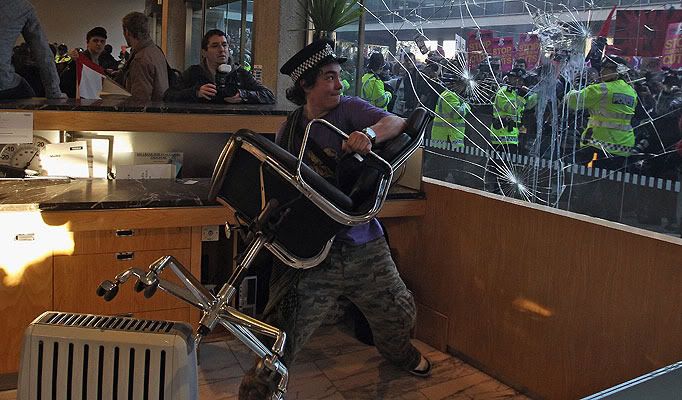
They got angry. Some of them got very angry, and while I was too late to see how it started, I sat on the sofa and watched in amazement as students smashed windows and started fires at Millbank tower, which serves as the HQ for the Conservative party.
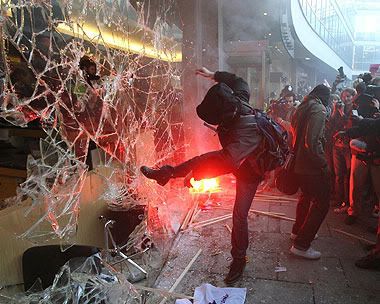
Our in-house punk was delighted, and it's not hard to see why. For years I thought that our generation had been placated by endless amusement; that youtube had given us all three-minute attention spans, and that I'd never see people my age care about anything as much as teenagers did in the 80s. They didn't particularly look like punks, as I remarked to Ben. He replied "Some of them are wearing jeggings, Anna. JEGGINGS." His point was that these are normal students. They're not a fringe group who identify themselves with rebellion, they are just normal people. At that moment, they were just normal people who had taken over Tory HQ, but still - normal people.
My heart goes out to the police officers who clearly wanted to be anywhere but there. They have a very tough job to do, and it does them credit (and gives me hope) to see that they responded without undue force. That's what separates us from dystopic fiction. (By the way, now's the perfect time to remind you about Little Brother. I bought a paperback copy and I'm lending it to people obsessively.)
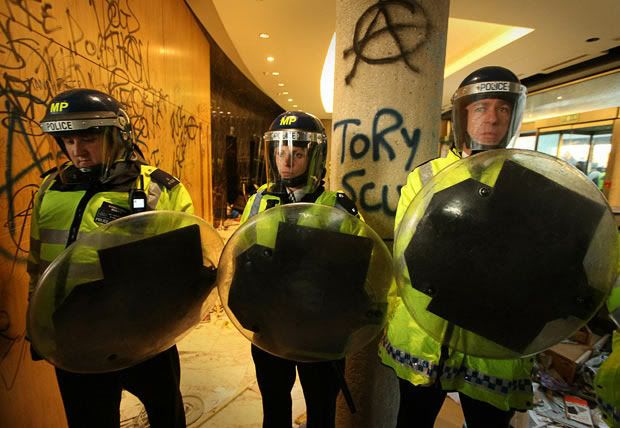
On the one hand, it's destructive and morally wrong. I don't hesitate to say that. I can't imagine how frightening it must have been for the people just doing their jobs in the building. My heart also goes out to the police officers who were injured on the job; and as for the twat who threw a fire-extinguisher from the roof - well, he's incredibly lucky nobody died. On the other hand... I'm part of a generation that cares enough to riot.
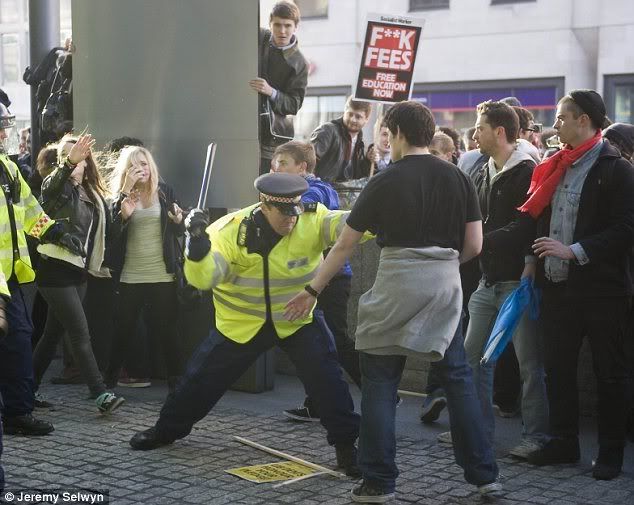
There were anarchist flags flying from the roof of Tory HQ yesterday, and while that may not be right, isn't it beautiful?
Recommended pictures:
Spanish journalists were on the scene, and got these incredible photos of the occupied building's lobby.
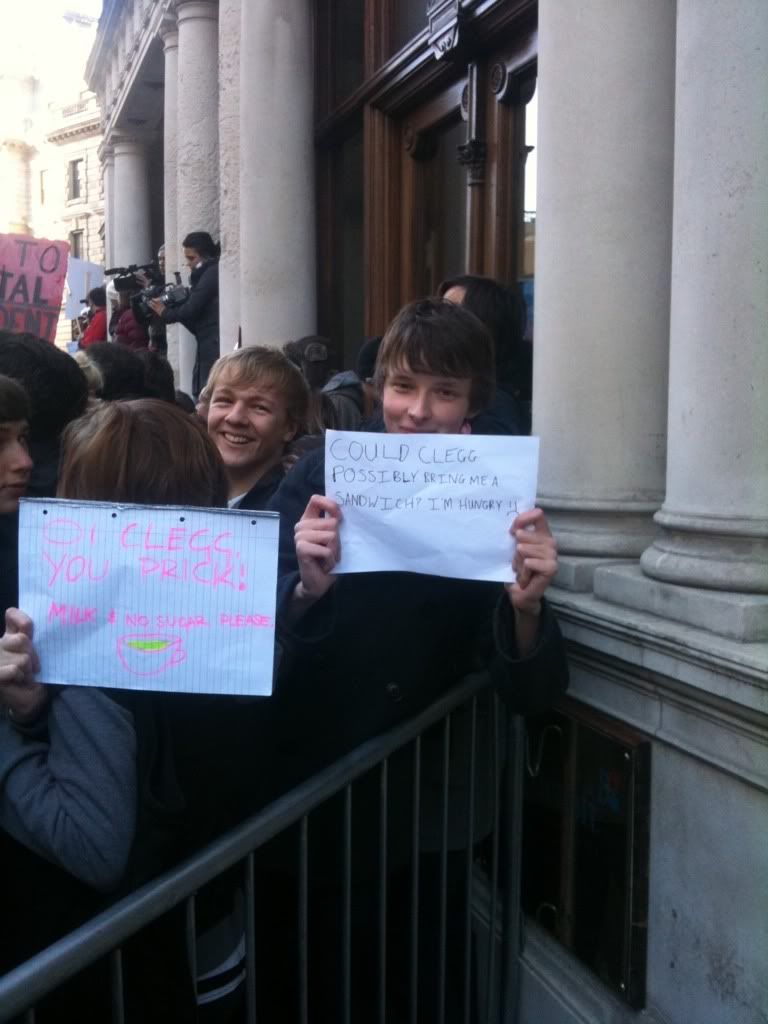
Funny banners and protest signs reflect the mood.